

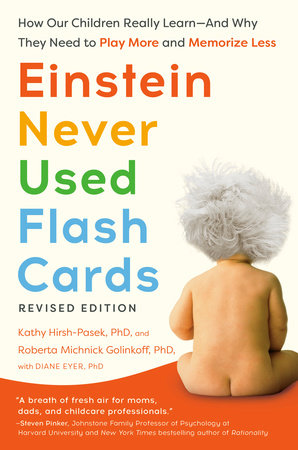
Einstein Never Used Flash Cards, Revised Edition

How Our Children Really Learn--And Why They Need to Play More and Memorize Less

About the Book

An enlightening guide to how infants, toddlers, and children learn and why play is the key to enhancing your child’s development—now revised and updated with a new chapter on the impacts of screen time

“An authoritative, up-to-date playbook on why we should raise our children to be learn-it-alls, not know-it-alls—plus practical advice on how parents can do that!”—Angela Duckworth, New York Times bestselling author of Grit

“A breath of fresh air for moms, dads, and childcare professionals.”—Steven Pinker, Johnstone Family Professor of Psychology at Harvard University and New York Times bestselling author of When Everyone Knows That Everyone Knows

In Einstein Never Used Flash Cards, award-winning early childhood development experts Kathy Hirsh-Pasek, PhD, and Roberta Michnick Golinkoff, PhD, show how parents can help their children succeed while reducing the pressures they both face. They offer a compelling message for today’s parents: rather than invest in expensive enrichment programs and “educational” apps and toys, the best way to boost brainpower and interpersonal skills is to let children play. In fact, free and guided play is a better way for kids to learn and for parents to enjoy their children.

Drawing on overwhelming scientific evidence, Hirsh-Pasek and Golinkoff explain how learning works from a child’s point of view. They address how kids pick up key mathematical concepts, acquire language, develop a sense of self, and more. They also offer more than forty age-appropriate activities for children under nine. These simple, fun—yet powerful—exercises work as well or better than unnecessary interventions to engage kids and their ever-active, curious minds. This revised edition also includes the latest findings on how play supports learning, as well as a new chapter on the benefits and downsides of time spent with digital media.

Packed with insights from fascinating studies and reassuring advice, Einstein Never Used Flash Cards empowers readers to help their children thrive while bringing more joy to the hard work of parenting.
Read more
Close

Praise for Einstein Never Used Flash Cards, Revised Edition

“An authoritative, up-to-date playbook on why we should raise our children to be learn-it-alls, not know-it-alls—plus practical advice on how parents can do that!”—Angela Duckworth, Rosa Lee and Egbert Chang Professor at the University of Pennsylvania and New York Times bestselling author of Grit

“A compelling case to stop drilling—and start making learning fun. This book is a breath of fresh air; it’s anchored on strong science, it’s full of practical tips for parents and teachers, and it’s more relevant than ever.”—Adam Grant, #1 New York Times bestselling author of Hidden Potential and Think Again, and host of the podcast Re:Thinking

Einstein Never Used Flash Cards offers an exceptionally clear-eyed—and reassuring—guide to what really matters for your child's development and how to develop a growth mindset. Einstein heralds the return of joyful parenting and real learning—mistakes and all!”—Carol S. Dweck, PhD, Lewis and Virginia Eaton Professor of Psychology at Stanford University and author of Mindset

Einstein Never Used Flashcards changed how we think about children and learning. In this outstanding new edition, Kathy Hirsh-Pasek and Roberta Golinkoff take on our screen-saturated world, showing how play, curiosity, and human connection still matter most. Smart, humane, and deeply practical, this is essential reading for parents, teachers, and anyone who cares about how children grow.”—Paul Bloom, professor of psychology at the University of Toronto and Yale University, and author of Psych: The Story of the Human Mind

“This book is a breath of fresh air for moms, dads, and childcare professionals who have been turned into anxious wrecks by the parenting industrial complex. With a light touch and an acute scientific eye, it analyzes what we do and don’t know about how to foster children’s development.”—Steven Pinker, Johnstone Family Professor of Psychology at Harvard University and New York Times bestselling author of When Everyone Knows That Everyone Knows

“A smashingly good book.”—Edward Zigler, PhD, director, Yale’s Center in Child Development and Social Policy, and the “father” of Head Start programs

“Parents will find a valuable message if they stick with the program, ultimately relieving themselves and their offspring of stress and creating a more balanced life.”Publishers Weekly

“Parents will better comprehend each of the significant areas of development—math, reading, verbal communication, science, self-awareness, and social skills—and get a grasp of what is scientifically proven to help children learn and grow. . . . Highly recommended.”Library Journal
Read more
Close
Close
Excerpt

Einstein Never Used Flash Cards, Revised Edition

Introduction

It’s no wonder that parents and educators are tired and frazzled. We have been caught in a whirlwind of cultural assumptions about how to raise and educate the next generation. We are told that faster is better, that we must push learning along at a rapid pace. We are told that we must make every minute of our children’s lives count, that our children are like empty rooms to be filled by the adults who serve as the interior designers of their lives. These assumptions about children and how they learn are at complete odds with the messages coming from the halls of academe, where child development experts have researched how children grow and learn. This book tells the story of development not only from the scientist’s point of view but also from the vantage point of two scientists who are also parents and grandparents. It thus offers an antidote not only to the hurried child but also to the hurried parent and hurried teacher!

The seeds for this book were first planted back in the mid-1980s, when Professor David Elkind of Tufts University came to Philadelphia to speak about his classic book, The Hurried Child. Professor Elkind had his finger on the pulse of the problem long before the “decade of the brain,” when parents were told they had to put their children’s brain development on their to-do list. He worried about the adultification of children as they began to appear draped in Baby Gap attire while participating in an array of adult-oriented activities revamped for preschoolers—everything from computer science to cooking classes to soccer leagues. His warning signs appeared even before parents could get quick child-rearing advice with just two keystrokes on the internet. I (Kathy) was a junior professor at Haverford College, doing research on “hurried children,” and I was thrilled to host Professor Elkind during his speaking tour. I was also a parent of two young children: Josh, age 4, and Benj, age 2. While I knew that Professor Elkind was theoretically right about finding more downtime with our children and enjoying more playtime, I also felt the pain of hurried parents. Every time my friends would tell me about another art class or another soccer league for toddlers, I worried that my children would be left behind in the rush toward success.

As a developmental psychologist, I knew that Professor Elkind was correct about the plight of the modern-day parent and child. Yet it took all the knowledge I had to resist the temptation to push my children too far and too fast. Using child development as my guide, I let them play. And 23 years later, I am happy to report that they survived my parenting and grew up just fine into happy, intelligent, and very creative people. Two of my sons are professors, and one is an entertainer. Hindsight really is 20/20.

At the same time, I (Roberta) was raising my two children while a professor at the University of Delaware. Jordy (now Jordan) was 9 and Jesse was 5. I remember when my son interviewed to attend a private school and I wondered whether I had failed him by not teaching him to read. But he was 4! The culture had worked its effect on me, despite the fact that I should have known better: I was a developmental psychologist. And yet I resisted because I knew that pushing children can backfire and create children who dread learning. It’s not that we sat at home. We did our share of music classes and religious instruction, but we tried to draw the line in the sand at the extras that would have taken away the children’s cherished playtime.

When my children were offered coed ballroom dance classes at a country club, I blew the whistle. But it wasn’t easy to say “no.” The invitations were embossed! And many of my friends’ children participated. But, as I have since learned from my children (now 46 and 42), they treasured the time they had to play at home and with their peers. Recently, my younger son told me that as a child, he played a game with the fingers on his hand, imagining that they were a family and each had a role. He loved that game. My son loved the extra staircase we had before we renovated our kitchen because it was such a great place to play hideand-seek. And they both remember playing inside a box we received with a delivery of an appliance and turning it into their private hideaway. Did they miss out because they didn’t take those dance lessons and learn how to interact in mature ways with the opposite sex? Have they suffered socially for lack of the foxtrot or box step? I don’t think so. My son graduated from an Ivy League college, worked with Teach for America, and is now saving the planet by selling carbon credits. My younger son has a master of public health and is empowering people who are underserved. Both are caring, happy, and resourceful people.

Both of us now get to relive the joys of child-rearing through our grandchildren. Would you believe that together we have ten-and-a-half grandkids, and we are seeing up-front and center how difficult it is to sift through all the noise about parenting. We don’t know about you, but if we were this bombarded by pamphlets, bloggers, podcasts, and television programs about how to be better parents, we would have gone crazy.

We tell you these things so that you know that even we, trained to understand how children grow and develop, had our doubts in trying to forge a balance for us and for our children and in our grandkids. We tell you these things so that you know that you are not alone when you follow your “gut” and say no to that extra activity that all the other kids are doing. We tell you these things so that when your children grow older, they, too, can look back and tell you how important the time they shared with friends and family was to them and their development and how happy it made them.

Why This Book Now?

The pages of this book were written to share the remarkable story of child development with parents, practitioners, and policymakers. The last 5 decades have witnessed an unparalleled burst of scientific study on infants and toddlers, and we have been privileged to be a part of this revolution with our colleagues around the world. As scientists, each with more than 40 years in the research field, and as parents ourselves, we genuinely want to help children and parents get their lives back. We want you to know the story of how children develop so that you can make wise choices based on scientific evidence and then apply your knowledge at home, in the classroom, and in policies for children.

Much of what the media and social media reports about research on child development contains only a grain of scientific truth. News stories, podcasts, blogs, and advertisements tell parents that toys build better brains and that infants and toddlers are mathematical geniuses. Nope. They really don’t, and we have studied this. Here we set the record straight. We chart the terrain of how children really learn as we help you to move from the scientific journals to practical applications of the research. Stocked with “teachable moments” and sections where you can “discover hidden skills” in your children, this book will empower you to resist the temptation to try to create young geniuses and will better equip you to raise happy, healthy, and intelligent children.

About the Author

Kathy Hirsh-Pasek, PhD
Decorative Carat

About the Author

Roberta Michnick Golinkoff, PhD
Decorative Carat

About the Author

Diane Eyer, PhD
Decorative Carat

By clicking submit, I acknowledge that I have read and agree to Penguin Random House's Privacy Policy and Terms of Use and understand that Penguin Random House collects certain categories of personal information for the purposes listed in that policy, discloses, sells, or shares certain personal information and retains personal information in accordance with the policy. You can opt-out of the sale or sharing of personal information anytime.

Random House Publishing Group