

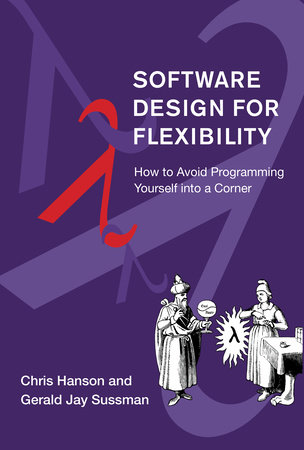
Software Design for Flexibility
How to Avoid Programming Yourself into a Corner
Chris Hanson and Gerald Jay Sussman
Hardcover
March 9, 2021 | ISBN 9780262045490
AmazonBarnes & NobleBooks A MillionBookshop.orgHudson BooksellersPowell'sTargetWalmart
Ebook
March 9, 2021 | ISBN 9780262362474
AmazonApple BooksBarnes & NobleBooks A MillionGoogle Play StoreKobo
About the Book
Strategies for building large systems that can be easily adapted for new situations with only minor programming modifications.
Time pressures encourage programmers to write code that works well for a narrow purpose, with no room to grow. But the best systems are evolvable; they can be adapted for new situations by adding code, rather than changing the existing code. The authors describe techniques they have found effective--over their combined 100-plus years of programming experience--that will help programmers avoid programming themselves into corners.
The authors explore ways to enhance flexibility by:
Organizing systems using combinators to compose mix-and-match parts, ranging from small functions to whole arithmetics, with standardized interfaces Augmenting data with independent annotation layers, such as units of measurement or provenance Combining independent pieces of partial information using unification or propagation Separating control structure from problem domain with domain models, rule systems and pattern matching, propagation, and dependency-directed backtracking Extending the programming language, using dynamically extensible evaluators
Time pressures encourage programmers to write code that works well for a narrow purpose, with no room to grow. But the best systems are evolvable; they can be adapted for new situations by adding code, rather than changing the existing code. The authors describe techniques they have found effective--over their combined 100-plus years of programming experience--that will help programmers avoid programming themselves into corners.
The authors explore ways to enhance flexibility by:
Read more
Close
