Excerpt
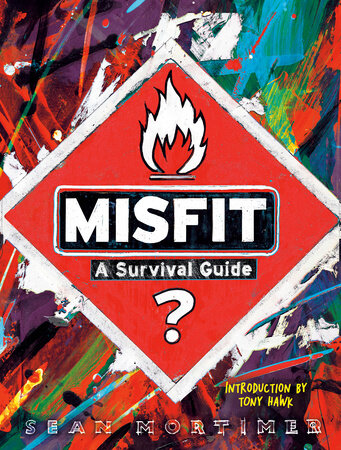
Misfit
1Wait, Instructions Aren’t Included?I don’t know about you, but life didn’t go on for too long before I felt an abrupt awkwardness, like I was an irregular jigsaw piece failing to snap together cleanly with others.
Laughing at an absurd social situation that draws puzzled looks from others. Getting peeled from conversations about mainstream interests after struggling to muster attentiveness. Dropping a contextual movie line from a cult film—“Yeah, yeah! Let’s go get sushi and not pay.”—comes off as troubling, obscure and random, perhaps indicative of an apparent neurological tic.
How exactly did this stray jigsaw piece find its way into the wrong puzzle box again?
The world loves to celebrate misfits—after the fact. Oh, look at the inexhaustible strength of the independent hero charging from the fringe! Tales are retold, obstacles are enlarged, troops inspired, unconventional beliefs put into practice until they swirl into mythological quests. Huckleberry Finn. Luke Skywalker. Lady Gaga. Einstein. Joan of Arc. Bowie. Tony Hawk. Galileo. David Lynch. Cyndi Lauper. Johnny Rotten. Sinéad O’Connor. Cool Hand Luke. Wu-Tang Clan. Dalí. RuPaul. Frida Kahlo. Kurt Cobain. Basquiat. Bob Dylan. Lil Nas X. Patti Smith. Billie Eilish. The focus shining on how their seemingly supernatural force of will blasted the weird, the unconventional, the alternative, the counterculture into conventional society. In hindsight, how could they not mutate the world?
As a culture, we celebrate tales of underdog victory, concealing a defining characteristic of the misfit journey—the fact that no misfit starts the game by choice. All the misfits I’ve known—from ragamuffin artists to awkward kids at Magic: The Gathering game nights to bouncing hyperpop avant-gardists to world-famous oddballs who changed mainstream perceptions of music, sports, and art—started off trying to fit in. Desperately. And we all sucked at it.
“Underdog” suggests playing a game against a favored opponent, as if we all agreed to the rules, shook hands to assure sportsmanship, and voluntarily stepped across the chalked line on the field competing for a shared idea of a win.
The harsh truth is, in the beginning, misfitting is anything but a conscious choice to play a game with clearly defined rules. Nobody inflicts this level of personality-shredding rejection on themselves if they have another option.
But veteran misfits know it’s a force necessary to eject us out of conventionality. It’s the first painful step on the misfit journey, though it feels more like a sucker punch followed by a shove off a cliff. You find yourself dazed, bruised, and in unfamiliar territory, forced to take an unconventional and often painful trip.
Speaking from experience, the sense of disorientation and disconnection at this point is sickening. Uncertainty, panic, and fear mix to create some seriously rancid emotions. But that changes when you realize how these outcast discomforts serve a purpose.
That said, you’re still going to have to slog through the emotional and social muck. You’re going to get lost and get cold and, out of an ugly desperation, be forced to discover new pathways. Obstacles will intentionally be placed on your path. The promise of control and security that makes conformity so addicting will be startlingly absent until you realize that what had felt like a broken compass leading you astray was pointing in a very specific direction.
If this book does anything, I hope it brings an understanding of how to use your misunderstood navigational tool. First you’ll learn how to traverse this strange, unfamiliar landscape. Then you will progress to mapping your own unique path as confusion transforms into confidence.
This book explores the experiences of a diverse group of misfits to collect shared survival skills that can help outcasts of all kinds, regardless of labels like age and gender or where you are in your journey through nonconformity. The quickest way to expire in a wilderness is to panic. Knowing that others were exactly where you are and made it out rouses hope and possibility. At the very least, I hope this book offers some company when it feels the loneliest.
Spoiler alert—the misfit journey never ends. Regardless of age and circumstances, every misfit must still interact with a society nursing a hardcore addiction to conformity. But know that it is possible to not only survive but thrive with your oddball self.
My more experienced misfit friends and I still find ourselves in circumstances where we feel socially rejected. The difference is that now, instead of cratering our self-confidence, it produces a pleasurable sting of awareness that tugs a small smile. In those moments, not fitting in reminds us of what we’ve earned. What used to feel like a curse now fizzes with effervescent gratitude. We understand the joys of misfitting.
Land of ConfusionWhen conversations with misfits touch on childhood, a familiar origin story emerges. I’m not sure if it can be attributed to mutation of the DNA code, residue of a rebellious reincarnation, or some spicy spiritual ingredients peppered in right before birth. Whatever it may be, early on there is an unsettling awareness that our social magnets were inserted incorrectly. The poles repelled rather than attracting and snapping together like everyone else’s. Often, before understanding there is recognition: What is this bewildering part of me that sparks to life and prompts me to take ridiculous stands against seemingly banal traditional asks?
This is a heady question to tumble around a child’s head, and reactions can span the spectrum. I cried a lot as a kid. Then I became a teenager and punched holes in my bedroom door. Confusing frustration leading to lashing out is a common theme with future misfits.
I helped Tony Hawk, the painfully skinny outcast kid who became the famous face of a renegade misfit activity still technically illegal in most cities—aka skateboarding—write his biography, and we called an early section “Demon Boy.” His mother once told me how a babysitter grew concerned over the toddler’s rage. Tony, sentenced to a stint in the crib, let his caretaker know what he thought about her authority. “She told me how Tony would scrunch his face up and throw his toy cars at her from his crib,” Mrs. Hawk said. “She really cared for Tony, but eventually left because the relationship wasn’t healthy for a developing child.”
When Tony left behind the crib, things didn’t change that much. Mrs. Hawk tried to teach him to play tennis, only to clue in to her son’s idea of the game after being tagged by balls a few times. “Tony, I think you’re trying to hit me.” To him it seemed like a sound strategy.
Even if they weren’t forced to participate in traditional athletics, future world champion misfits found ways to rebel. “I really got into a lot of mischief as a kid,” Stacy Peralta, Tony’s early mentor, says. The former pro skateboarder and current award-winning documentarian describes a childhood that makes it obvious why he and Tony connected. “I really loved throwing fruit at passing cars, dirt clods at windows. I was always getting into trouble. There was no mean intent—I had a very active imagination and was always having fun. I was always building things, doing models and very industrious, but I was always in trouble—I wanted to play.”
Oh, like play baseball in a uniform running along chalked lines with umpires and cheering parents?
Nope.
“I wanted to stick firecrackers in apples and throw them and see them explode in the air,” Stacy clarifies. “It was so much fun to have an orange explode on the roof of a passing car. To see a dirt clod break apart on a plate glass window and not break the window? That was like art. Cops came to my house three times, not for anything bad, just that I blew a firecracker off in some lady’s windowsill.”
As humans, we are not wired to be stoked about being cast off and alone. Shame. Guilt. Anxiety. Fear. Anger. Regret. Take a whack at the elaborate piñata that is the misfit brain and see what awkward emotional assortments scatter across the ground. Even when one isn’t inclined to express inner feelings with rotting fruit or toy car projectiles, those same feelings can corkscrew inward. Stomachaches, hyper-competitiveness, panic, tears, fears, anxiety, anger, isolation, crumbling self-confidence. When there are no instructions included, no premade mold to pour emotions into, they have a habit of spilling all over the place.
The artist Seneca specializes in wonderfully tripped-out images as well as being the lead designer behind the infamous “Bored Ape” NFT character. Considering her staid family background, it says something that when given free rein, she used an emotionally vapid primate to create a wicked caricature of ennui, that untranslatable French word describing a particular flavor of soul-crushing, blown-out boredom.